
AI Security Compliance & Risk Management: A Strategic Guide for Security Leaders
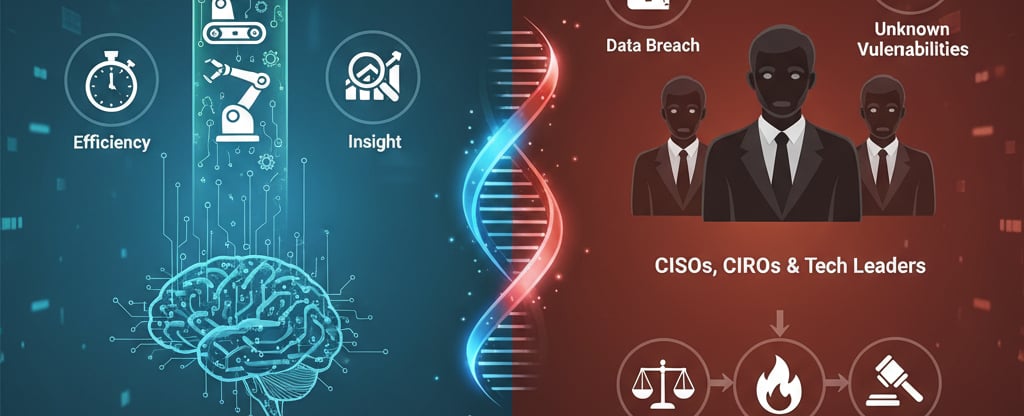
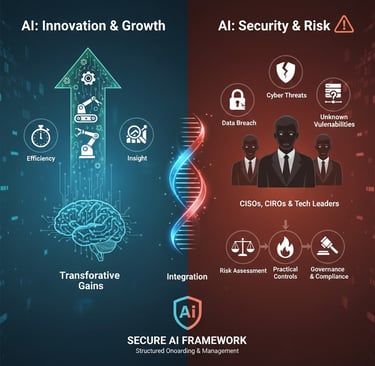
The integration of Artificial Intelligence (AI) into organizational processes is no longer a question of "if" but "how." While AI promises transformative gains in efficiency, automation, and insight, it introduces a new frontier of risk. For CISOs, CIROs, and other technology leaders, the mandate is clear: enable innovation without compromising security, compliance, or operational resilience. This guide provides a structured framework for securely onboarding and managing AI products, focusing on risk assessment, practical controls, and governance.
5/8/20245 min read
Executive Summary
The rapid adoption of Artificial Intelligence (AI) across enterprises has created unprecedented opportunities for automation, predictive analytics, and enhanced decision-making. Yet this transformation brings complex security challenges that demand structured approaches to risk management and compliance. For CISOs, CIROs, Security Managers, Security Directors, CIOs, and SMB leaders, the secure onboarding of AI products requires navigating intricate landscapes of data privacy, model integrity, regulatory requirements, and operational resilience.
This comprehensive guide addresses the critical security considerations that organizations must evaluate when implementing AI technologies. Through practical frameworks, risk assessment methodologies, and actionable checklists, security leaders can establish robust governance structures that enable innovation while maintaining security posture and regulatory compliance
1. The AI Security Imperative: Beyond the Hype
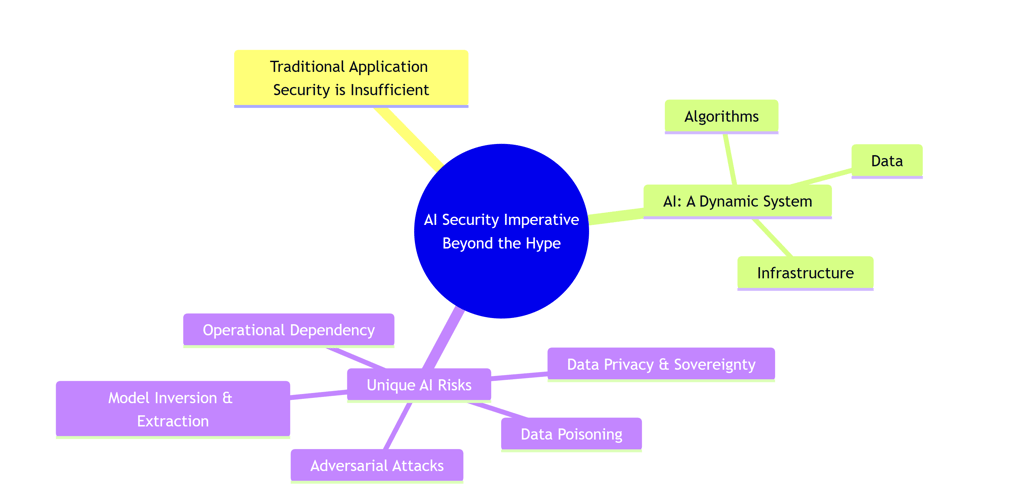
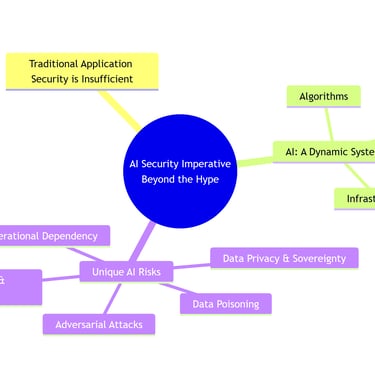
AI is not just another piece of software. It is a dynamic system comprising data, algorithms, and computational infrastructure, each layer introducing unique vulnerabilities. A traditional application security model is insufficient. The risks are multifaceted:
Data Poisoning: Malicious manipulation of training data to corrupt the AI model's behaviour.
Model Inversion & Extraction: Attacks designed to steal proprietary model logic or infer sensitive information from its outputs.
Adversarial Attacks: Crafting subtle inputs that cause the model to make catastrophic errors.
Data Privacy & Sovereignty: AI models often process vast amounts of PII, PHI, and intellectual property, triggering GDPR, HIPAA, and other regulatory concerns.
Operational Dependency: The failure of a critical AI-driven process can halt business operations.
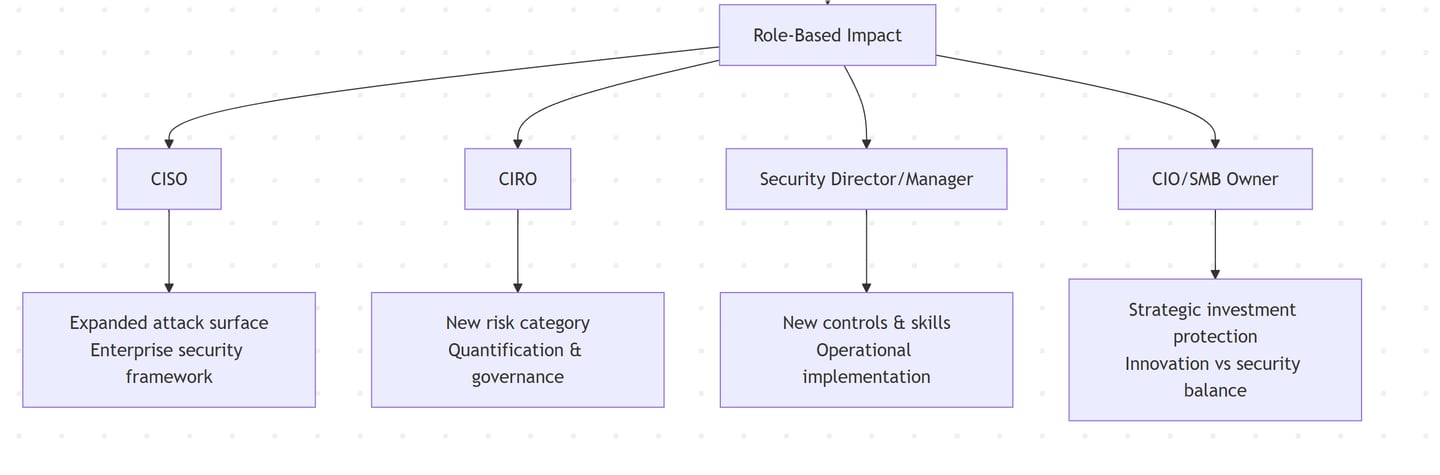
For the CISO, this represents an expansion of the attack surface. For the CIRO (Chief Information Risk Officer), it's a new and complex risk category to quantify and manage. For the Security Director/Manager, it demands new skill sets and controls. For the CIO and SMB owner, it's a strategic investment that must be secured to protect the organization's future.
2. A Role-Based Perspective on AI Risk
AI is not just another piece of software. It is a dynamic system comprising data, algorithms, and computational infrastructure, each layer introducing unique vulnerabilities. A traditional application security model is insufficient. The risks are multifaceted:
Data Poisoning: Malicious manipulation of training data to corrupt the AI model's behaviour.
Model Inversion & Extraction: Attacks designed to steal proprietary model logic or infer sensitive information from its outputs.
Adversarial Attacks: Crafting subtle inputs that cause the model to make catastrophic errors.
Data Privacy & Sovereignty: AI models often process vast amounts of PII, PHI, and intellectual property, triggering GDPR, HIPAA, and other regulatory concerns.
Operational Dependency: The failure of a critical AI-driven process can halt business operations.
3. Foundational Pillars for Secure AI Onboarding
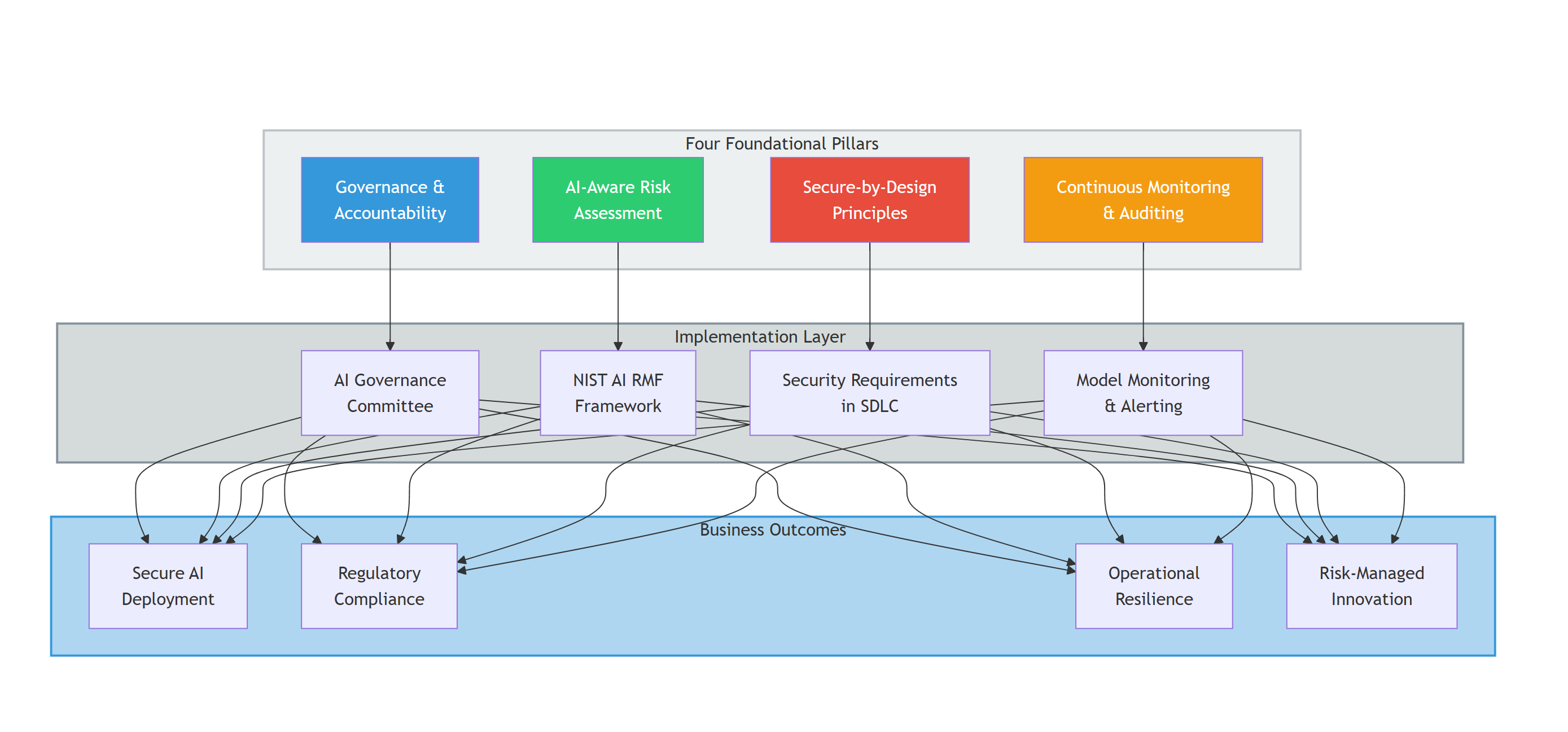
Before procuring any AI product, establish these four pillars:
Governance & Accountability: Define clear ownership. Who is responsible for the AI model's security, outputs, and ongoing monitoring? Establish an AI Governance Committee with representatives from Security, Legal, Compliance, and Business Units.
AI-Aware Risk Assessment: Integrate AI-specific risks into your enterprise risk management (ERM) process. Use frameworks like the NIST AI Risk Management Framework (AI RMF) to structure your approach.
Secure-by-Design Principles: Mandate that security is a non-negotiable requirement in the AI procurement and development lifecycle, not an afterthought.
Continuous Monitoring & Auditing: AI models can "drift" and become less accurate or secure over time. Implement logging, monitoring, and regular audits of model behaviour and data inputs.
4. Pre-Implementation Risk Assessment: The FAIR Methodology Applied to AI
A qualitative "High/Medium/Low" risk rating is inadequate. We recommend a more quantitative approach using the Factor Analysis of Information Risk (FAIR) model to contextualize AI risk.
Scenario: Assessing the risk of a new Customer Service Chatbot that processes personal customer data.
Identify Loss Event: Unauthorized access to and exfiltration of customer PII via a vulnerability in the chatbot's model API.
Estimate Probable Frequency:
Threat Event Frequency (TEF): How often are AI APIs targeted? (Consider threat intelligence feeds).
Contact Frequency: How many interactions does the chatbot handle daily? (High).
Probability of Action: What is the likelihood a threat actor will attempt to exploit this? (Medium-High, given the value of PII).
Estimate Probable Magnitude of Loss:
Primary Loss: Regulatory fines (e.g., GDPR at 4% of global turnover), customer notification costs, and forensic investigation fees.
Secondary Loss: Reputational damage leading to loss of customers, decrease in stock price (for public companies).
Derive Risk: By quantifying the frequency and magnitude, you can calculate a financial range for the risk (e.g., $500k - $2M annually). This allows the CIRO and CISO to present a business-case-driven argument for security controls.
5. Case Study: Secure AI Implementation at "FinServe Corp"
Background: FinServe Corp, a mid-sized financial services firm, sought to implement an AI-driven fraud detection system.
Security Integration & Challenges:
Challenge 1 (Data): The model required training on highly sensitive transaction data.
Action: The security team, in collaboration with the Data Privacy Officer, implemented differential privacy and synthetic data generation for the initial training phases, minimizing exposure of real customer data.
Challenge 2 (Model): The vendor's model was a "black box," creating transparency and compliance issues.
Action: The CIRO mandated a Model Card and Explainable AI (XAI) requirements in the contract. The vendor provided documentation on the model's limitations, fairness metrics, and tools to explain individual decisions to regulators.
Challenge 3 (Operational): How to detect model drift or adversarial attacks in real-time?
Action: The Security Directors integrated the AI system into their SIEM. They created alerts for anomalous patterns in the model's input data (potential poisoning) and output decisions (potential drift or attack).
Outcome: After a 6-month pilot, the AI system reduced false positives in fraud detection by 40% without a single security or compliance incident. The pre-defined governance structure allowed for quick escalation and resolution of a potential data anomaly flagged by the monitoring system.
6.AI Security Compliance: Do’s & Don’ts
6.1 Do’s
✅ Conduct AI security assessments before deployment.
✅ Ensure AI compliance with industry and regulatory standards.
✅ Implement security monitoring for AI threats and anomalies.
✅ Use AI explain ability tools to validate model decisions.
✅ Secure AI APIs and restrict unauthorized access.
6.2 Don’ts
❌ Do not deploy AI without proper risk assessment.
❌ Do not use black-box AI models without transparency.
❌ Do not rely on a single security layer for AI protection.
❌ Do not overlook adversarial threats in AI models.
❌ Do not store sensitive AI training data without encryption.
7. AI Security Onboarding Checklist
8.Next Steps: Secure Your AI Systems Today
AI security is complex, and ensuring compliance while mitigating threats requires expertise. If you’re planning to onboard an AI product or need a cybersecurity expert to assess and secure your AI infrastructure, our team can help.
🔹 Understand your AI security risks
🔹 Get a tailored compliance strategy
🔹 Ensure AI security best practices are in place
Schedule your free consultation today! 📅 Book a Free Consultation
Let’s ensure your AI-powered business remains secure, compliant, and resilient. 🚀
#cybersecurity #AIsecurity #GenAIsecurity #Datasecurity #GDPR #Complainces #Security #informationsecurity #ciso #cyberthreats