
Enhancing Cybersecurity: Essential Services for Modern SMB Businesses
Think your SMB is too small for cybercriminals? Think again. In today's digital landscape, proactive cybersecurity isn't optional—it's essential for survival and growth.
5/8/20244 min read


In today's digital-first economy, small and medium-sized businesses (SMBs) are the backbone of innovation and growth. However, this position also makes them a prime target for cybercriminals. The misconception that SMBs are "too small to be targeted" is a dangerous myth. In reality, their often-limited security resources make them attractive entry points into larger supply chains or low-risk, high-reward targets for ransomware.
For founders, CISOs, managing directors, and leadership teams, cybersecurity is no longer a niche IT concern—it is a fundamental business imperative. A single breach can lead to devastating financial losses, irreversible reputational damage, and significant regulatory penalties. This article outlines the essential cybersecurity services that modern SMBs must implement to build a resilient and proactive defense posture.
The Shifting Landscape: Why SMBs Are at Risk
The cybersecurity landscape for SMBs is more perilous than ever. Cybercriminals have automated their attacks, using tools that can indiscriminately target thousands of businesses at once. According to a recent Verizon DBIR, 43% of cyberattacks target small businesses
Key challenges include:
Sophisticated Phishing Campaigns: Highly targeted emails that trick employees into revealing credentials or installing malware.
Ransomware-as-a-Service (RaaS): This model allows low-skilled attackers to launch devastating ransomware attacks, with SMBs being frequent victims. [Placeholder for ransomware cost statistic.]
Supply Chain Attacks: Compromising a smaller vendor to gain access to a larger partner's network.
Regulatory Pressure: Compliance requirements like GDPR, CCPA, and industry-specific standards are becoming more stringent.
The message is clear: a reactive approach is a recipe for disaster. Proactive investment in essential cybersecurity services is not a cost; it's an investment in your business's continuity and future.
The Essential Cybersecurity Service Portfolio for SMBs
Building a robust cybersecurity framework doesn't mean building an expensive, in-house security operations center (SOC). Instead, SMBs can leverage a curated portfolio of services, often provided by Managed Security Service Providers (MSSPs), to achieve enterprise-grade protection.
1. Managed Detection and Response (MDR)
What it is: MDR goes beyond traditional antivirus by providing 24/7 monitoring of your network and endpoints (laptops, servers, etc.) for suspicious activity. It combines advanced technology with human expertise to hunt for threats, not just wait for alerts.
Why it's essential: MDR acts as your always-on security team, identifying and containing threats like advanced malware and insider threats before they can cause significant damage.
2. Vulnerability Management
What it is: This service involves regularly scanning your systems, applications, and networks to identify known security weaknesses (vulnerabilities). It then prioritizes them based on severity and provides guidance for patching or mitigation.
Why it's essential: You can't fix what you don't know about. Vulnerability management provides a clear, prioritized roadmap for strengthening your digital infrastructure, closing the doors before attackers can walk through them.
3. Security Awareness Training and Phishing Simulations
What it is: Your employees are your first line of defense—or your weakest link. This service provides ongoing, engaging training on cybersecurity best practices. Coupled with simulated phishing attacks, it turns theoretical knowledge into practical, habitual vigilance.
Why it's essential: [36% of data breaches involve a phishing credential theft.] Training reduces human error, which remains the leading cause of security incidents.
4. Incident Response (IR) Retainer
What it is: Hope for the best, but plan for the worst. An IR retainer is a pre-arranged agreement with a cybersecurity firm to provide immediate expert assistance in the event of a breach. This ensures a swift, coordinated, and effective response to minimize impact.
Why it's essential: In the chaotic aftermath of a breach, time is critical. Having a team on standby saves precious hours and days, helping to contain the incident, eradicate the threat, and begin recovery immediately.
5. Compliance and Risk Management
What it is: This service helps you navigate the complex web of industry regulations and data privacy laws. It involves assessing your current posture, identifying gaps, and implementing the policies and controls needed to achieve and maintain compliance.
Why it's essential: It protects you from hefty fines and legal action. Furthermore, a strong compliance framework often overlaps significantly with a strong security framework, killing two birds with one stone.
6. Identity and Access Management (IAM)
What it is: IAM is the practice of ensuring the right individuals have the right access to the right resources at the right times. Core components include enforcing Multi-Factor Authentication (MFA), managing user privileges, and controlling access to cloud applications.
Why it's essential: Compromised user credentials are a primary attack vector. IAM, especially MFA, is one of the most effective controls to prevent unauthorized access, even if a password is stolen.
Visualizing Your Cybersecurity Strategy: An Integrated Flow
A successful cybersecurity posture is not a collection of isolated tools but an integrated, continuous cycle. The flowchart below illustrates how these essential services interconnect to create a dynamic and resilient defense system.
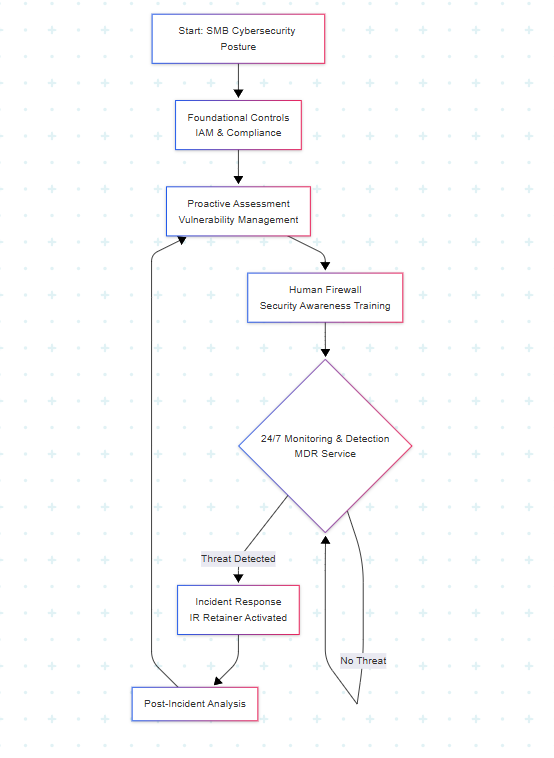
How to read this flow:
It begins with establishing Foundational Controls (IAM and Compliance), which form the bedrock of your security program.
These foundations enable Proactive Assessment (Vulnerability Management) to identify weaknesses.
Simultaneously, building the Human Firewall (Security Awareness Training) addresses the human element.
These efforts feed into the continuous cycle of 24/7 Monitoring & Detection (MDR).
When a threat is detected, the Incident Response plan is activated to contain and eradicate the threat.
Crucially, the process ends with Post-Incident Analysis, where lessons learned are fed back into the proactive phases, creating a cycle of continuous improvement.
Conclusion: From Reactive to Proactive Resilience
For SMB leaders, the question is no longer if you will be targeted, but when and how. Waiting for a breach to occur before taking action is a gamble with existential stakes. The cybersecurity services outlined here provide a practical, scalable blueprint for building a defense that can not only withstand modern threats but also enable business growth by fostering trust with customers and partners.
By taking a proactive, service-driven approach to cybersecurity, you are not just protecting your data—you are safeguarding your reputation, your financial stability, and the very future of your business. The time to invest is now.